
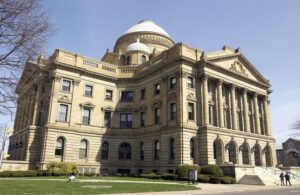
The demand for language interpreters continues to increase in Luzerne County’s court system — a trend officials have been observing for years, statistics show.
In 2023, the courts logged 4,369 instances requiring interpreters, which it calls “events.”
That number grew approximately 30% in 2024, when there were 5,661 interpreter events, said county Court Administrator Paul Hindmarsh.
Court administration is still gathering documentation for all events in 2025, but Hindmarsh said he is confident it will exceed the previous year.
Looking back for comparison, the courts provided interpreters 1,137 times in 2016, when court officials started highlighting the emerging dynamic. By 2018, the number had increased to 2,065.
By law, courts must provide interpreters in all civil and criminal proceedings and for court preparations and over-the-counter interactions in all court branches, Hindmarsh said. This mandate applies beyond the county Court of Common Pleas to include 16 magisterial district court offices, central court, probation services, domestic relations, and protection-from-abuse, or PFA, services, he said.
Assistance ranges from in-court language translation to help filling out forms, Hindmarsh said.
“It really runs the gamut. It hits everywhere,” he said.
An estimated 15.9% of the county’s 331,379 residents age 5 and older speak a language other than English at home, according to the latest U.S. Census data.
But residents are not the only ones with language barriers interacting with the court, Hindmarsh pointed out. Court cases also involve people passing through the county, which has two major interstates and the turnpike, he said.
Interpreter expenses totaled $560,468 in 2024. That figure includes both two in-house staff Spanish interpreters and outside translators necessary due to the workload or when the language involved is not Spanish, he said.
Last year’s total cost is still being finalized through billing, but Hindmarsh estimates it will exceed $640,000.
The state covers a portion of the expense, but this reimbursement has not kept pace with rising costs, Hindmarsh said.
For 2024, the state reimbursement was approximately 33%, covering $184,548 of the $560,468 in expenses, his statistics show.
Hindmarsh had informed County Council of the rising interpreter costs during his budget presentation last October
Outside interpreters of all languages are freelance and procured through the Administrative Office of Pennsylvania Courts, or AOPC. These interpreters regularly travel from other areas of Pennsylvania, particularly the Philadelphia area, and from several neighboring states, officials said.
Freelance interpreter rates are set by the state and based on their level of state certification. The rates currently range from $45 to $80 per hour, $140 to $260 for a half day, and $270 to $475 for a full day, Hindmarsh said.
“It is a very expensive endeavor,” he told council in October.
The county is “very privileged” to have the two full-time staff Spanish interpreters, which “helps ease the burden just a little bit,” Hindmarsh said.
County Councilman Harry Haas noted at the time that this certification is “intense and very important.” Hindmarsh concurred, saying the testing is “extremely difficult.”
Both staff interpreters have completed the grueling written and oral state certification test required to provide Spanish translation in major court proceedings, with one only recently achieving that certification to be “fully utilized” as needed in court, Hindmarsh said.
Spanish translation is the most in demand, followed by American Sign Language interpreters, the county said.
The eight remaining languages requested in 2024, from highest to lowest, according to the county court: Haitian Creole, Russian, Chinese, Arabic, Vietnamese, Ukrainian, Swahili, and Bengali. Rarer languages included Hindi, Georgian, Uzbek, Gujarati, and Guinean Fulani, it said.
According to a county court summary, equal access to the courts is “fundamental to the legitimacy” of the justice system and necessary to maintain public trust and confidence.
“Language services for individuals who speak limited English or are deaf or hard of hearing are essential to ensure that they are able to fully participate in judicial proceedings and court services, programs, and activities in which their rights and interests are at stake,” it said. “Without these services, they are effectively denied the protection of our laws.”
Leave a Reply
You must be logged in to post a comment.